

-2.png?width=804&height=595&name=_-%20visual%20selection%20(6)-2.png)
When a child struggles in school, it is natural for adults to assume the problem is strictly academic. We might think they need more reading practice, haven’t memorized their math facts, or simply need to focus harder. But sometimes, the root of the issue isn’t a lack of understanding or effort. Sometimes, the issue is a lack of flexibility.
Many children do not struggle because they cannot learn the material; they struggle because they cannot shift their thinking when their initial approach fails. They might get stuck on a single math strategy and refuse to try another. They might insist a word is correct even when it does not make sense in context. When corrected, they might shut down, or when directions suddenly change, they might become completely overwhelmed.
What can easily be misinterpreted as laziness, defiance, or low confidence is often a manifestation of something much deeper: an underdeveloped executive function skill known as cognitive flexibility. Recognizing this can empower parents and educators to support meaningful, lasting growth.
What is Cognitive Flexibility?
-1.png?width=753&height=354&name=_-%20visual%20selection%20(7)-1.png)
Cognitive flexibility is the mental ability to adjust your thinking when circumstances change, to think creatively "outside the box," and to view a problem from a new perspective.
It is a core component of our brain’s executive functions. The Harvard Center on the Developing Child famously compares executive function to a highly effective "air traffic control system" at a busy airport. Just as air traffic control manages the arrivals and departures of dozens of planes on multiple runways to prevent collisions, our brain's executive functions help us hold onto information, filter distractions, and switch gears efficiently.
According to renowned developmental neuroscientist Dr. Adele Diamond, executive functions—which include working memory, self-control, and cognitive flexibility—are incredibly strong predictors of academic and life success. Crucially, a struggle with cognitive flexibility is not a reflection of intelligence. A child can be exceptionally bright and still find it difficult to shift strategies. Flexibility is fundamentally about adaptability. It is the ability to pause, rethink, and say, “That didn’t work, let me try again a different way.”
Why Flexibility Matters in the Classroom
.png?width=753&height=367&name=_-%20visual%20selection%20(8).png)
School demands cognitive flexibility constantly. Throughout a single day, students must follow multi-step directions, transition abruptly between subjects, revise their written work, and adjust to the differing expectations of various teachers.
A child who can mentally adapt sees these transitions as manageable. However, a child who struggles with cognitive flexibility may experience each shift or correction as deeply stressful.
This directly ties into the work of psychologist Carol Dweck on the "growth mindset." Children who believe they can improve possess a growth mindset and are much more willing to try new strategies after making mistakes. Flexible thinkers view mistakes as useful data. Rigid thinkers, on the other hand, tend to see mistakes as permanent proof that they are simply “bad” at something.
The Good News: Flexibility Can Be Built
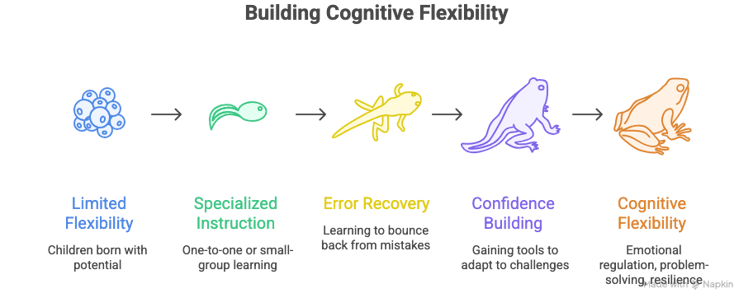
The most encouraging news for parents is that children are not born with fully formed executive function skills—they are born with the potential to develop them.
The part of the brain responsible for reasoning and emotional regulation continues to mature throughout childhood. Research clearly demonstrates that executive function skills are highly trainable. With our specialized, one-to-one or small-group instruction, students learn to recover much more quickly from errors. They gain profound confidence—not because the work magically becomes easy, but because they finally possess the cognitive tools to adapt when it gets hard.
Cognitive flexibility is far more than just a "school skill." It influences emotional regulation, robust problem-solving, and lifelong resilience, ultimately helping children become confident, adaptable individuals well beyond the classroom walls.
The Eardley Difference: Building Flexibility in Practice
.png?width=753&height=403&name=_-%20visual%20selection%20(10).png)
At Eardley Education Solutions, we recognize that executive functioning is the "command center" of the brain. Typical tutoring often relies on a rote "question-and-answer" format or simply reteaching the same material louder and slower. We take a fundamentally different approach.
Through our Adaptive Multisensory Instruction (AMI)™ and dedicated Executive Function Coaching, we directly target rigid thinking and intentionally build cognitive flexibility:
-
Multisensory Problem Solving: We teach students that there is always more than one way to solve a problem. In math, we use the Concrete-Representational-Abstract (CRA) sequence, allowing students to "see" and "feel" concepts with hands-on manipulatives before moving to standard numbers. In reading, we use Orton-Gillingham and Lindamood-Bell’s Visualizing and Verbalizing® methodologies to build a mental "visual dictionary." If one pathway isn't clicking, we fluidly shift to another
-
Explicit EF Coaching: We do not just hope adaptability develops; we explicitly coach "Flexible Thinking." We equip students with the personalized systems they need to adapt to challenges, shift gears when they feel overwhelmed, and build robust problem-solving skills for both schoolwork and daily responsibilities
-
Data-Driven Reflection: During the Reflection phase of our 5-step methodology, we use Curriculum-Based Measurements (CBMs) to review progress with the student. We normalize mistakes as a necessary part of the learning process and model out loud how to rethink an approach when a strategy is less successful
Does your child shut down any time the situation changes?
Learn more about our Executive Function Coaching today to learn more
about how we can strengthen your learner's cognitive flexibility!