
With more than 18 years of experience in the education sector, we are incredibly fortunate to have Dr. Courtney Mustafa serving as our Director of Instruction here at Eardley Education Solutions. In this role, she oversees instructional quality and student outcomes while providing high-level professional development to our Learning Coaches.
Dr. Mustafa is a lifelong learner who holds two Master’s degrees and a Doctorate in Education. Her career spans public, charter, and private school settings, where she has served as a classroom teacher, educational consultant, instructional leader, and district administrator. Through her experience in these diverse roles, Dr. Mustafa recognized the limitations of standard reading curriculums, particularly for students who are differently abled. This drove her to work in collaboration with school psychologists, behavioral therapists, and school teams to ensure that every child receives the specific interventions necessary for success.
Grade retention is one of the most polarizing and fiercely debated topics in modern education. Is it a necessary intervention to ensure students master foundational skills, or is it a punitive measure that inflicts long-lasting psychosocial harm?
Currently, approximately 2 million children are retained each year in the United States, meaning 10% of all students will be held back at least once before they reach high school. Despite its prevalence, education researchers remain divided on whether the long-term outcomes are positive, neutral, or negative.
This comprehensive guide explores the history of test-based retention policies, the demographic disparities of the practice, its psychosocial toll on students, and new qualitative research uncovering how adults perceive their childhood retention.
Table of Contents
- What is Grade Retention vs. Social Promotion?
- The Evolution of Test-Based Retention Policies
- The Hidden Demographic Disparities in Retention
- The Psychosocial Impact: Industry vs. Inferiority
- Short-Term Academic Gains vs. Long-Term Outcomes
- A Qualitative Look: Adult Perceptions of Grade Retention
Want to read the full research? Download Dr. Courtney Mustafa’s complete 80-page doctoral dissertation:
"The Outcomes of Grade Retention: Perceptions of Adults Retained in Grades K-8" here.
What is Grade Retention vs. Social Promotion?
.png?width=804&height=271&name=_-%20visual%20selection%20(22).png)
To understand the debate surrounding student progression, we must define the two primary—and opposing—educational policies.
Grade Retention: An educational practice that requires underperforming students to repeat their current grade level. This acts as a form of remediation, theoretically granting the student an additional full year to master grade-level academic or social standards before moving on.
Social Promotion: The practice of passing low-performing students onto the next grade level based primarily on their age, rather than their academic proficiency.
Proponents of retention argue that it is vital for content areas like reading and math, which require foundational knowledge before moving to advanced concepts. Conversely, advocates against retention argue that social promotion prevents the social stigmatization and stress associated with being separated from peers.
The Evolution of Test-Based Retention Policies
.png?width=804&height=729&name=_-%20visual%20selection%20(23).png)
Grade retention is not a modern concept; schools in the 1870s used written exams to determine promotion. However, the modern era of "test-based retention" began in the late 1990s and early 2000s, largely driven by state and federal education reform.
The No Child Left Behind Act of 2001 (NCLB) instituted strict accountability standards that strongly discouraged social promotion. States responded by adopting policies requiring students to pass standardized assessments to advance.
-
Florida's Early Literacy Focus: Enacted in 2002, Florida's policy mandated that public schools focus heavily on early literacy. Third-grade students who fail to meet proficiency on standardized reading tests are held back, paired with "highly effective" teachers, and given intensive reading interventions.
-
The National Spread: Following the Every Student Succeeds Act of 2015, universal literacy by third grade became a national priority. Today, over 30% of states have adopted test-based retention policies.
The Hidden Demographic Disparities in Retention
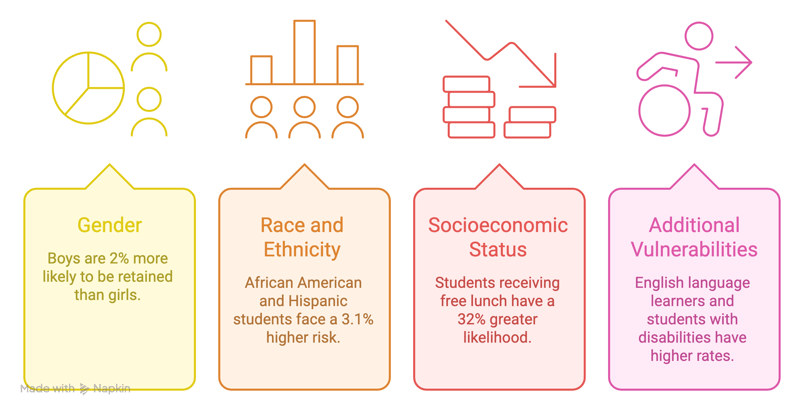
One of the most concerning aspects of modern grade retention policies is the disproportionate impact on vulnerable student populations. Data reveals stark inequalities in who is held back:
-
Gender: The risk of being retained is 2% higher for boys than for girls
-
Race and Ethnicity: African American and Hispanic students face a 3.1% higher risk of retention compared to White students. Furthermore, there is a statistically significant correlation between higher Black student enrollment and the adoption of state test-based retention policies
-
Socioeconomic Status: Students receiving free or reduced-price lunch have a 32% greater likelihood of being retained—even if they maintain average grades in school
-
Additional Vulnerabilities: English language learners and students with disabilities also experience disproportionately higher retention rates
These disparities are troubling, as the inequitable application of retention can lead to long-term negative outcomes for minority and low-income communities, including higher rates of poverty, unemployment, and incarceration.
How do these demographics impact long-term adult success?
Get the full data and qualitative interviews in Dr. Mustafa’s complete thesis here.
The Psychosocial Impact: Industry vs. Inferiority
.png?width=804&height=658&name=_-%20visual%20selection%20(24).png)
Beyond academic metrics, retaining a child can severely impact their social and emotional well-being. To understand this, education researchers often look to Erikson’s theory of psychosocial development.
During elementary and middle school, children are in a developmental stage characterized by the conflict of "industry versus inferiority". At this age, children constantly compare themselves to their peers to measure their own success.
When a student is retained, they watch their peers graduate to the next level while they are left behind. This visible, perceived "failure" can trigger deep feelings of inferiority. Research indicates that retained students frequently report:
-
Feeling like a "misfit" within their environment
-
Experiencing higher incidences of bullying and social exclusion
-
Harboring life-long "disturbances" in confidence that can persist into adulthood
Short-Term Academic Gains vs. Long-Term Outcomes
.png?width=804&height=404&name=_-%20visual%20selection%20(25).png)
If retention carries significant psychological risks, does it at least improve academic achievement? The data is mixed.
When retention is paired with heavy academic interventions—such as summer reading programs and placement with high-performing teachers—students often show substantial short-term gains in math and reading. However, research shows that these academic benefits tend to fade after five years.
Conversely, the long-term negative outcomes are highly documented. Retained students are:
-
More likely to drop out of high school
-
Less likely to pursue higher education
-
More likely to display psychosocial maladjusted behaviors
A Qualitative Look: Adult Perceptions of Grade Retention
Because the vast majority of research on grade retention relies on quantitative data (test scores, dropout rates, and statistical trends), there is a significant gap in understanding why these outcomes occur.
To bridge this gap, Dr. Courtney Mustafa conducted a basic qualitative study involving semistructured interviews with adults (ages 21 to 40) who were retained in Grades K-8. By capturing their lived experiences, the research sheds light on how these individuals perceive the long-term influences of retention on their educational and social lives.
Understanding the student perspective is critical. By giving a voice to those who lived through these education policies, educators and legislators can make better-informed decisions that support student growth without sacrificing their psychosocial well-being.
Explore the First-Hand Accounts of Retained Students
Discover the groundbreaking qualitative research conducted by
Eardley Education Solutions'Director of Instruction, Dr. Courtney Mustafa, here.